Trump's New Monroe Doctrine
A Sign of a Weakening Empire Battening Down the Hatches

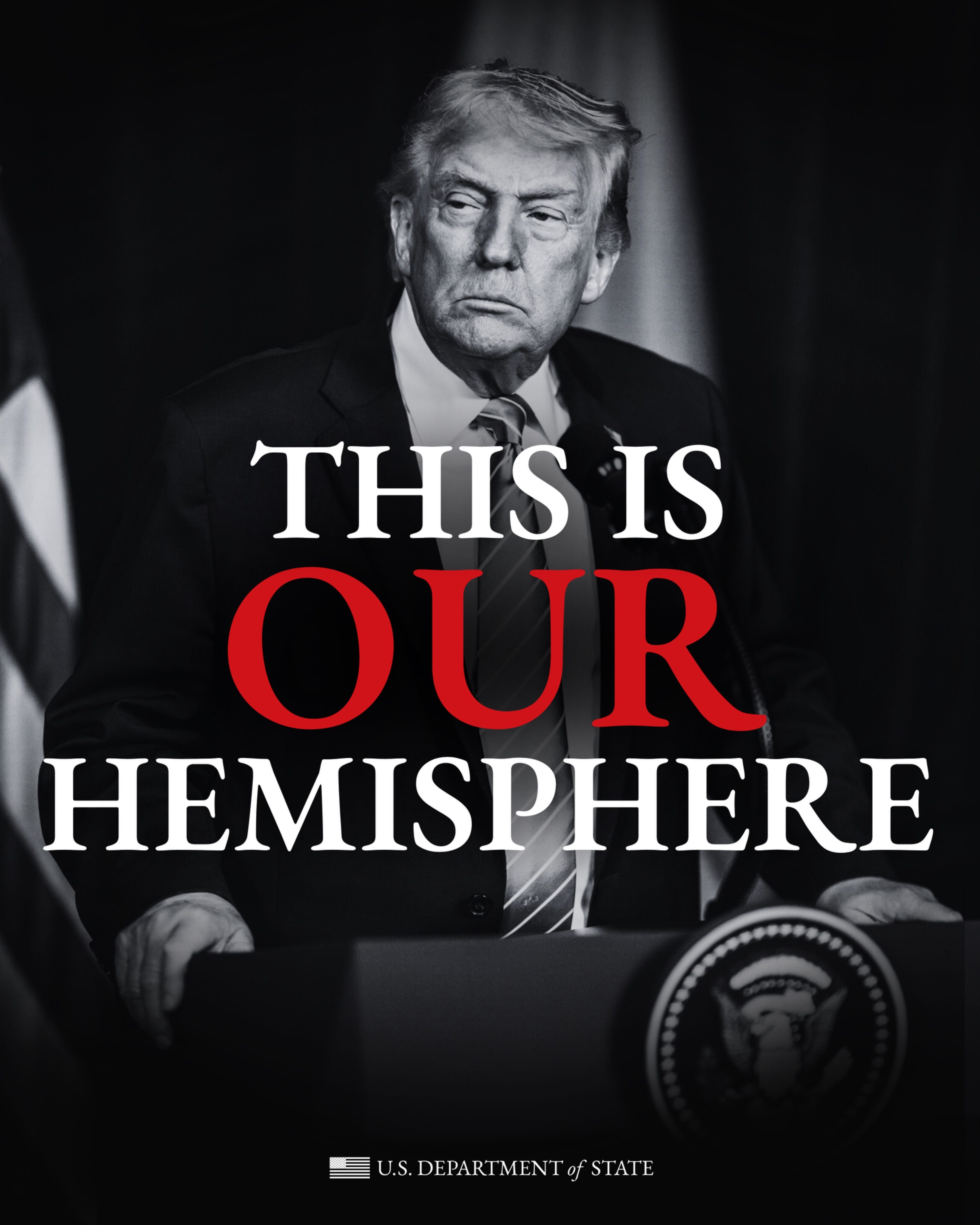
The old Monroe doctrine of 1823 rested on three main aims (i) Europe was not allowed to colonize or recolonize anywhere in the Western Hemisphere (ii) any attempt by European nations to gain control over any Western Hemisphere nation would be treated as a security threat by the US (iii) the US would not interfere in European politics, or those of European colonies.
The US has come a long way since 1823, establishing itself as a global empire overseeing vassal states in Europe, Asia (South Korea and Japan), and Australasia (Australia and New Zealand), while exploiting vast swathes of the globe. But that US empire is now in decline, seeing mainland Asia slip from its hands and its greatest rival, China, go from strength to strength. Its ability to exploit other nations is being increasingly restricted by the presence of China as a trade and FDI competitor in so many nation; a China that has only grown stronger as the West attempted to knee cap its development through technology sanctions and tariffs. With Russia also providing military muscle to sub-Saharan nations resisting Western exploitation.
The part of the US oligarchy that supports “Open Door” globalization (i.e. the US forcing open other nations’ societies to US domination and exploitation) has shrunk as the ongoing costs of that policy keep rising while the returns are reduced through Chinese competition and increased nationalism. In contrast, the “America First” part of the oligarchy is becoming dominant. This does not mean that there will be a turn away from empire, but rather a more cost effective structure put in place and the Western Hemisphere “homeland” shored up against foreign (Chinese) competition. The position and policies of the Trump administration are increasingly becoming the consensus of the US oligarchy. Do not expect a major change whenever a Democrat inhabits the Oval Office, both parties are just the different arms of the US oligarchy.
Firstly, the vassals must pay a much greater share of the costs of maintaining the empire through both massively increased military expenditures (much of which will be spent on goods from the US MIC), and through the acceptance of unequal treaties that allow for greater US exploitation and a move of part of their productive forces to the US. Europe is in no way pulling away from the US, instead its vassal leaders are deepening its dependence while pulling even more political, economic and diplomatic control toward the safe-from-democracy supranational EU apparatus. The UK is doing the same, while also incrementally moving back into the oversight of the EU bureaucracy; a “Reverse Brexit” as the Duran calls it. This will allow greater US focus on Asia, with Australia and Japan acting as its vanguard, while its Asian vassals also increase military spending and accept unequal treaties.
The US is moving to a form of “offshore balancing”, using its Asian vassals and other nations to increasingly augment its own forces to offset the growing power of China, with its European vassals and other nations taking on Russia. The recalcitrant Iranians will be dealt with through the proxy Israel. But for this to work, the US must be in control of its own “backyard”, the Western Hemisphere. This need provides the basis for many of the administration’s policies, which are meeting with considerable success.
The returning of Bolivia, Honduras and Chile to US vassal control.
The solidification of US vassal control in Ecuador.
The victory of Milei in the Argentinian October 2025 election.
The attempt at regime change in Venezuela through a maritime blockade, in addition to the extensive economic and financial sanctions that are already in place, and now the kidnaping of its head of state.
In Central America, Guatemala, El Salvador, Honduras, Costa Rica and Panama are ruled by US vassals. In South America, US vassals rule Peru, Ecuador, Bolivia, Paraguay, Argentina and Chile. In the Caribbean, only Cuba is the real standout. The two largest economic entities of Brazil and Mexico still resist vassal status, along with Venezuela, Colombia and Nicaragua. We should expect extensive US interference in the upcoming April elections in Peru, May elections in Colombia, and the October elections in Brazil, together with increasing pressure upon Mexico (presidential election in 2030) and Nicaragua (elections November 2027). At the same time, China is the largest trading partner for Central and South America.
The new Monroe Doctrine is aimed at not just stopping independent nationalism and foreign (other than US Empire) interference in Central and South America, but also putting in place the US control of resource exploitation within the each nation to the detriment of China; the US to get “first dibs” on any strategic resources within the region, such as rare earth minerals, fossil fuels, and lithium. Also, to gain control over the huge agricultural exports from the region, which compete directly with the US agribusiness sector, that help feed China. As the strength of China continues to grow, and Southeast and Central Asia become more and more integrated with China and Russia, the urgency and aggressive nature of this new Monroe Doctrine will escalate. The move to subjugate Venezuela will be a turning point, either showing the rest of the Americas the power of the US or displaying its weakness; even with the kidnapping of the Venezuelan head of state this is still an open to question. The vassals need to be regularly reminded of what happens to elite groups in Latin America that resist US power.
The problem for the US is that money talks, the money made from increasing exports to China and the money invested by China in an increasing number of FDI projects. The problem for China is that the US policy is to interfere directly in the internal working of countries to keep the vassal elites in power, and to punish non-vassal elites, while China has a position of non-interference in the internal affairs of other nations. China dangles the carrot of increasing profits and economic development to the region’s elites while the US dangles the carrot of support for its vassal elites but also waves a big stick in front of them.
In this respect, a Brazil with the region’s biggest economy, a large trade surplus with China, and increasing levels of Chinese FDI stands out as the one nation that may be able to withstand the US big stick while enjoying the export profits. The right wing may even win the October elections, but its oligarchy may still forge a relatively independent path, given the national scale and relative distance from the US. Here again, the outcome of the attempted regime change operation on Venezuela becomes very important. With US vassals to the west of Brazil (Argentina, Chile, Paraguay, Bolivia and Ecuador) and a vassal Venezuela on its northern border, its elites may feel significantly constrained in their actions. A position made even worse if a US vassal is elected in Colombia in May.
The other major standout is Mexico, the second largest economy in the region and with a very long border with the US. With the US vassals of El Salvador, Guatemala and Honduras at its southern border. We can expect increasing attempts at destabilizing the current Mexican government, given that new presidential elections will not be held until 2030. Without control over its “backyard” of the Northern Hemisphere, the US will be in a much weaker position to act as an offshore balancer. Such a situation is anathema to the US oligarchy, and it may very well utilize greater and greater levels of political interference and military aggression if it is unable to establish Western Hemisphere hegemony. The problem with the latter is that it could easily suck the US into a quagmire that only serves to deepen its decline.
There is of course the northern vassal of Canada, but the reality there is that the domestic oligarchy is fully in bed with their US counterparts. The new prime minister from Goldman Sachs and the Bank of England may have made some edgy remarks during his election campaign but has in reality pretty much delivered what his bosses want (massive increases in defence spending while cutting social spending, ending fiscal support for green energy and transport electrification, more funding for Ukraine and utter support for the Zionist regime) covered up with disingenuous rhetoric and complaints about US policies.
The Trump administration is very explicitly saying to the other nations in the Western Hemisphere that they will not be allowed to sit on the fence between US and Chinese interests, but must rather pick the US side or be the target of a myriad of US attacks - including military if necessary - to bring them into line. The ability of Venezuela to resist the current blockade, and its new head of state to resist ongoing US aggression, and of Mexico and Brazil to steer a middle course, will be indicative of the strength or weakness of the US. If the US administration is successful, the possibility of an at least de facto seizure of Greenland should not be taken lightly.
>de facto seizure of Greenland
USA already has de facto control. Outright seizure and changing USA government maps would be a PR stunt to affect USA elections. Cuba has been preserved as independent because invasion was always a no-win situation for any USA President dumb enough to invade, and this logic is also what ultimately protects Canada and Mexico, provided they more or less cooperate with USA. Whereas Greenland and Denmark can offer no resistance. There is a large crowd of yahoos in the USA who are suffering economically under Trump's policies but would be mightily impressed by an expanded USA on the world map (Greenland looks huge in Mercator projection) and the virtue-signaling Democrats who would be outraged by seizure of Greenland won't vote Republican regardless. So there's something to be said for seizure, but it really depends on how the swing voters would react.
Seizing Greenland would also powerful signal the EU+Britain to fully cooperate with USA plans, otherwise USA can arrange to provoke Russia to attack EU+ or perhaps arrange a stoppage of oil flow from the Mideast, either of which would really wreck the EU+ economy. The signal is very powerful and can only be used once (though USA can also use seizure of various Caribbean islands under EU+British control as additional signals) so that's a reason to hold off using it.
Spot on.