Milei’s Argentina Nightmare Delayed
Milei & Trump Pulled Off The Short Term Big Steal

Courthouse News Service
Coming into September 2025, it looked as if the legislative election in Argentina may in fact deliver a huge loss to Javier Milei and his oligarch agenda, so every possible avenue of support had to be utilized to keep that agenda in place:
Earlier in the year, the US-controlled IMF had already doled out more money to Argentina; once again, against its own internal rules.
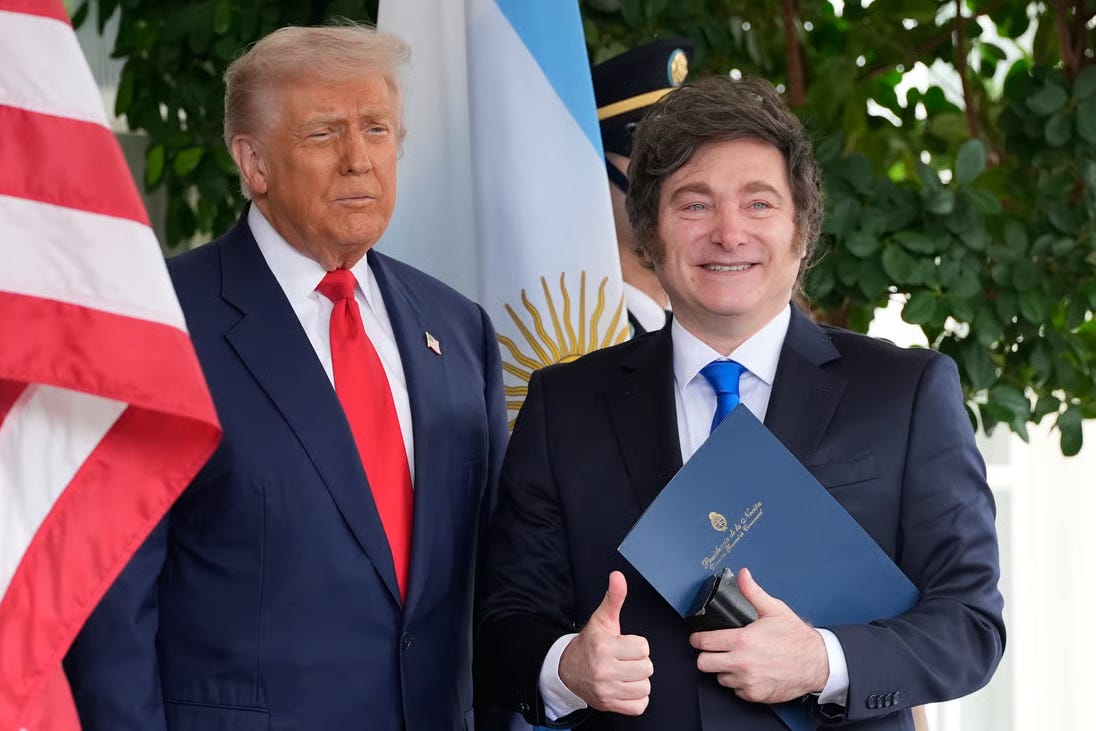
President Trump very publicly endorsed Milei, stating that Argentina would not be treated well by the US if the mid-term elections went against Milei.
The US extended a US$20 billion swap line to Argentina to halt what would have been the start of a collapse of the Argentine currency in the run up to the election.
The US Treasury directly intervened in the foreign exchange markets to halt the fall in the Argentine currency.
US banks publicly discussed a US$20 billion fund to invest in Argentina, now shelved after Milei won the mid-terms.
Milei removed some agricultural export taxes to drive exports in the short term to bolster the meagre foreign exchange reserves, losing the tax revenue.
The government statisticians played fast and loose with the inflation numbers, which also affect the inflation-adjusted growth number. In addition, growth in the financialized economy (rents) was counted as offsetting drops in products and other services.
And on October 26th, Milei’s La Libertad Avenida won 64 seats, to total 111 seats in the Chamber of Deputies. The opposition won 46 seats, to total 99, the new United Provinces party won 20 seats, the Workers Left party won 3 seats for a total of 8, and other parties have 10. There are 257 seats in total, so a ruling coalition needs 128 seats. The opposition does not have the ability to override Milei’s presidential vetoes as that would need a two thirds majority, so at the least Milei can block any attempt to roll back the changes that he has already made. Notable was the reversal of the move against Milei in the September local election in Buenos Aires at the national mid-terms; evidence of the effectiveness of the US interference in the national elections.
Milei will need to ally with the United Provinces and possibly other party members to get his future agenda passed, which includes:
Making it easier for rich people to cheat on their taxes by raising the thresholds for tax evasion and shortening the statute of limitations.
Banning budget deficits.
Making it even easier forArgentinian businesses to hire and fire workers and pay more flexible wages, while making it harder for unions.
Slash environmental regulations
The reality is that Milei created the same non-sustainable low inflation environment that Menem did in the 1990s; fix the exchange rate and keep it overvalued to tame inflation through domestic deflation combined with asset sales and foreign loans to keep topping up FX reserves until there is nothing left to sell and no one will lend. In Milei’s case, he has also been aided by the long term investment of the previous Peronist governments in increased natural gas production that has now resulted in increasing exports. And also China’s move away from sourcing agricultural imports from the US, which lead to increased imports from both Argentina and Brazil. Argentina is now a paradise for foreign investors, with investments of over US$ 200 million getting a 30-year relief on taxes, customs and regulations; a great way to suck in FX but disastrous for the the long term funding of the government.
The exchange rate is massively overvalued, with a Big Mac costing more in Buenos Aires than in New York. In the next year, Argentina has to make US$10 billion of debt payments. The one-off export benefit from the cutting of agricultural export taxes is already gone, and they were a major factor in the trade surplus of US$800 million in October (a fall from US$921 million in September); the current account balance is in deficit. In early December, agricultural export taxes were cut again, great for the agri-business oligarchy but horrible for government funding. With such a massively overvalued exchange rate, only deep domestic deflation and more short-term giveaways to foreign investors and exporters can maintain a trade surplus which brings in much needed foreign exchange.
Argentinian consumer prices rose 2.5% in November, after 2.3% in October, with annual inflation now rising to 31.4%; both numbers published after the October election. Recent government statistics that showed that the country had skirted a recession, when most private economists considered that it was in one, have been openly questioned. What is not open to question is that the country’s manufacturing industry is in a major crisis:
“We have to blow out inventory to cover day-to-day expenses,” said the industry leader, who also owns a factory in Greater Buenos Aires.
At the same time, imports of consumer goods are surging while domestic demand is constrained by personal indebtedness and increased debt arrears. Industrial production fell 2.9% y-o-y in October (and 0.8% month over month), and within that manufacturing saw significant and accelerating drops while petroleum and basic metals output showed some gains. What would be expected with an overvalued exchange rate, deindustrialization.
After falling from 1,076 pesos to the US$ to 1,475 in mid-September, the Argentinian currency has stabilized, but that large fall against the US$ will feed into domestic inflation over the next 6-12 months. In addition, the stability of the exchange rate is highly tenuous for a nation with nearly no foreign exchange reserves and utterly dependent upon pulling in foreign money to roll over debt and make interest payments; especially now that the trade surplus has dwindled. The unsustainable will keep being sustained as long as possible to facilitate the Argentinian and foreign oligarch looting of the country, maybe for a few more months, maybe for another year; who knows? But it will come to the same result as with Menem, a massive currency, financial and economic crash which will create yet greater destitution for the majority.
The current Argentina is a massive Potemkin Village now utterly dependent upon foreign financing. The nation’s external debt was US$305 billion in Q2 of 2025, an increase from US$281.3 billion in Q1, with significant debt maturities in 2026 and 2027. From January 1st of next year, the central bank will adjust the exchange rate band each month by the rate of inflation with a lag; the exchange rate will act much less as a deflationary mechanism, albeit from an overvalued starting point. The central bank has also committed itself to building up foreign exchange, by selling pesos for US$ in the open market, but this will put downward pressure on the very exchange rate that it is committed to keeping the value of within defined limits. With the trade surplus disappearing (the current account is already in deficit), the only thing that will allow the central bank to build reserves in this way is domestic deflation that will reduce consumption and boost the trade surplus.
External debt to GDP is forecast to be at 44% in 2025 and 50% in 2026, but that is flattered by the overvalued exchange rate. The currency is at least 20% overvalued, and with a free floating exchange rate would most probably overshoot fair value to the downside; rapidly increasing the US$ denominated foreign debt in relation to a falling US$ value of GDP. Without continued financial support, which will only increase the debt to GDP ratio even more, a required debt default and financial implosion on par with the early 2000s would be on the cards. That is the destination that the nation is travelling towards, the only question is that of how long Milei and his foreign friends will be able to/ready to keep the financial plates spinning. Any recession in Argentina’s major export markets of Brazil, the US and China and/or a financial crisis that forces a risk off move by Western investors and institutions could quickly precipitate a crisis. Or perhaps domestic unrest in the face of never-ending domestic deflation.
The difference between the coming implosion and that of the early 2000's is that USA ability to project power and conduct gunboat diplomacy is much weaker and weakening further as time passes. If USA is stalemated in Venezuela and Russia prevails in getting what it wants in Ukraine and perception of USA military power is otherwise damaged, there will be very strong temptation by Argentina to default. Many oligarchs will have already gotten their liquid wealth out of Argentina and be more worried about revolution than threats by distant USA to cut Argentina off from the western banking system, so they may decide to join the calls for default as a way of blaming someone else and deflecting attention from themselves. Plus even the slightest military threat allows instant and permanent freezing of all foreign owned assets in Argentina, as justified (kinda sorta) by the precedent of EU seizure of Russian assets.
Repudiation of debt is not discussed much nowadays because USA since 1945 has been able to make repudiation extremely painful. But things might be different in the future. Needless to say, partial repudiation is also possible: repudiate USA, EU, IMF debts, honor debts to China, South Korea, Japan and other countries that produce electronics and machinery that less developed countries truly need to import.
The steal of the deal was so easy even these 2 clowns were able to pull it off